
ILOILO – Dengue infections are showing a renewed surge in Iloilo Province, with 266 new cases recorded in just one week, prompting provincial health authorities to intensify calls for households and communities to eliminate mosquito breeding grounds.
The Iloilo Provincial Health Office (IPHO) said the 266 infections were recorded during morbidity week 34, covering Aug. 22 to 29, pushing the province’s cumulative dengue caseload to 2,668, including 12 deaths, from Jan. 4 to Aug. 29.
Dengue is a viral infection transmitted through the bite of an infected female Aedes aegypti mosquito. Symptoms may include sudden high fever, severe headache, joint and muscle pain, skin rashes and, in severe cases, bleeding.
Despite the recent increase, the year-to-date caseload remained 39 percent lower than the 4,348 cases and 18 deaths recorded during the comparable period last year.
Estancia emerged as the province’s dengue hotspot, accounting for 44 of the 266 new cases during the latest morbidity week. It was followed by Carles with 18 new infections, Lambunao with 15, Alimodian with 14 and Balasan with 13.
Estancia also has the highest cumulative caseload this year at 241 cases and four deaths, and the largest number of barangays experiencing clustering of dengue infections.
IPHO chief Dr. Maria Socorro Colmenares-Quiñon also stressed that parents and guardians should immediately seek medical consultation when children or other family members develop signs and symptoms of dengue.
There is no specific cure for dengue, and severe infections can be fatal without prompt medical attention.
The 12 fatalities recorded province-wide came from Estancia with four; Carles with two; and Ajuy, Sara, San Dionisio, Miag-ao, San Joaquin and Dingle with one each.
IPHO data showed Calinog had the second-highest number of dengue infections with 183, followed by Cabatuan with 165, Passi City with 143, Dumangas with 127, Carles with 126 and two deaths, Ajuy with 118 and one death, Concepcion and Lambunao with 90 each, and Alimodian with 82.
Other localities with cases were Oton, 80; Tigbauan, 77; Balasan and Batad, 72 each; Maasin, 71; San Enrique, 65; Santa Barbara, 64; Sara, 64 with one death; San Dionisio, 63 with one death; Pototan, 53; San Miguel, 51; Dingle, 49 with one death; Janiuay, 48; Banate, 43; Pavia, 42; San Rafael, 40; Miag-ao, 39 with one death; Leganes, 33; Bingawan, 29; Barotac Viejo and Dueñas, 28 each; Guimbal, 22; Lemery, 20; Leon and Zarraga, 19 each; Barotac Nuevo, 18; and San Joaquin, 17 with one death.
CHILDREN MOST AFFECTED
Children aged five to nine remained the most affected age group, accounting for 533 cases, followed by those aged 10 to 14 with 465 cases.
Those aged 20 to 29 accounted for 384 cases; 15 to 19, 368; 40 and older, 356; one to four years old, 309; 30 to 39, 140; and infants below one year old, 117.
The IPHO also identified municipalities and cities with multiple clustering barangays, defined as communities recording three or more dengue cases for four consecutive weeks.
Estancia had the most with 11 clustering barangays, followed by Passi City with seven, Concepcion and Carles with six each, and Balasan with five.
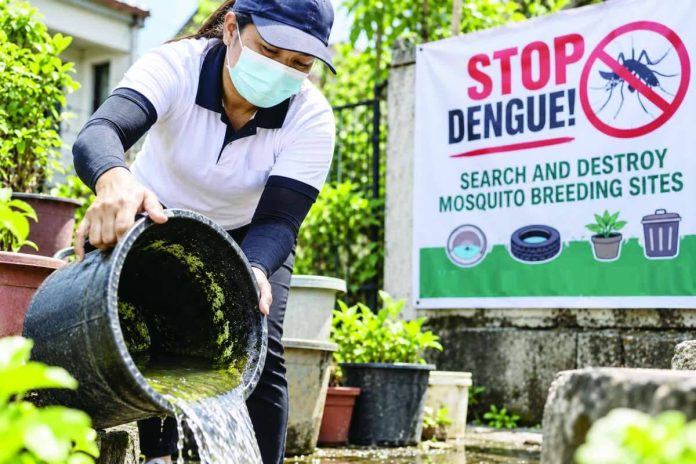
Amid the continuing increase, the IPHO reiterated its “search and destroy” strategy, urging residents to regularly inspect their homes and surroundings and eliminate stagnant water and other potential breeding sites of Aedes aegypti mosquitoes.
“With case continuing to rise, prevention starts in every home and every community. Search and destroy mosquito breeding sites,” the IPHO advised./PN