



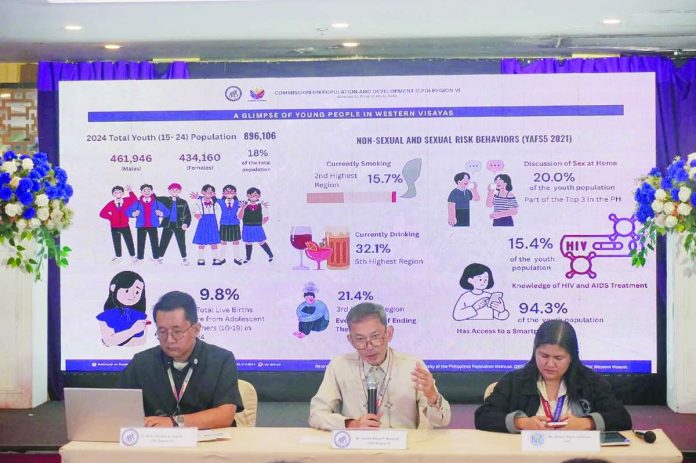
ILOILO City — Western Visayas has emerged as one of the country’s hotspots for youth smoking and drinking, with the latest Young Adult Fertility and Sexuality Study (YAFS) showing that the region posted the second-highest smoking prevalence and the fifth-highest alcohol consumption rate among Filipinos aged 15 to 24.
The Commission on Population and Development (CPD) has called for stronger intervention against risky behaviors among the region’s young people.
Data from the 2021 YAFS, the latest survey compiled by CPD Region 6, showed that 15.7 percent of Western Visayas youth are current smokers, while 32.1 percent consume alcoholic beverages, placing the region among the country’s highest-risk areas for substance use among adolescents and young adults.
The findings were presented by CPD-6 in line with this year’s observance of World Population Day and underscore the growing need for health education, stricter regulation of tobacco and alcohol access, and stronger family and community support systems for young people.
Harold Alfred Marshall, regional director of CPD-6, attributed the high figures largely to the easy accessibility of cigarettes and alcohol and the strong influence of peers and family.
“Well, access is one. Temptation and smoking are always. Pero ano ang nagakatabo? The psychology of engaging in non-sexual risky behaviors such as smoking, drinking, the psychology of that is the influence sang family, influence sang barkada,” he explained.
Marshall said adolescence is a stage when young people seek independence from their parents while trying to gain acceptance from their peers, making them more susceptible to smoking, drinking and other perilous practices.
“If wala ka gapanigarilyo, tawgon ka nga waay gapakisama, you are ‘uncool’, and that could put pressure sa isa ka gusto nga mangin myembro sang barkada. And that is not only limited to smoking, but also drinking, and even perhaps engaging sa mga risqué sexual behaviors,” Marshall said.
“Ikaw na lang ang wala nagapakisama, so the pressure is intense to fulfill that sense of belongingness; you have to engage in what your fellow barkadas are doing,” he added.
The widespread availability of tobacco products and alcoholic beverages further increases the likelihood that young people will experiment with them, Marshall lamented.
But, he stressed, “Kon armasan mo ang mga bata sa nagakaigo nga impormasyon, may posibilidad man nga indi sila mag-engage.”
Marshall cited the Department of Health’s YOSI KADIRI campaign as one of the government’s efforts to discourage smoking among the youth.
“That program helps influence sang decisions sang kabataan and the public in general not to engage in smoking,” he said.
Marshall acknowledged that despite ordinances enacted by some local government units to curb youth access to tobacco, enforcement remains difficult because of the tobacco industry’s extensive distribution and marketing network.
To further discourage smoking, he noted that the government has imposed higher excise taxes on tobacco products to make it more expensive to access.
Marshall, however, pointed out that the survey does not identify whether smoking is more prevalent in urban or rural communities, limiting the ability of authorities to localize interventions.
“The data is not broken down; it is a very generic survey on the access to smoking among adolescents and youth. If we can get a better idea kon diin gid mas damo gapanigarilyo, sa mga urban areas or rural areas, we can more or less localize our strategies,” he said.
As of 2024, Western Visayas has 896,106 residents aged 15 to 24, comprising 461,946 males and 434,160 females, according to CPD-6.
Marshall emphasized that behind the statistics are young people whose futures depend on informed choices and supportive communities.
“The data remind us that behind every statistic is a young person with dreams, potential, and the right to shape their own future. Our responsibility is not simply to address the challenges they face, but to create an environment where every young person can make informed choices, enjoy equal opportunities, and realize their hopes and aspirations,” he stressed./PN